
Blog
Chopper vs Blender Difference Explained

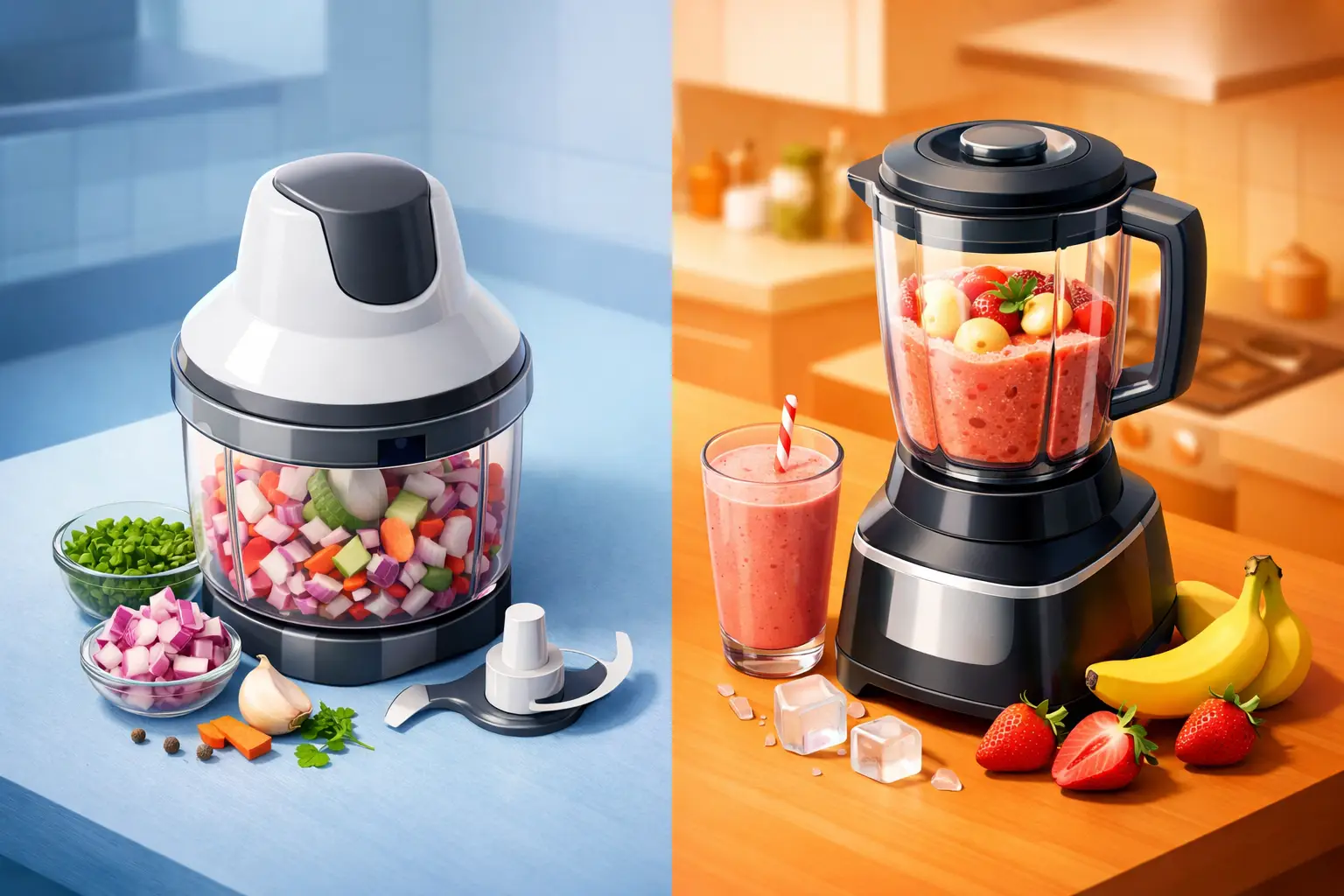
You notice the gap when dinner prep starts. One appliance turns onions, herbs, and nuts into quick, even cuts in seconds, while the other handles smoothies, soups, and sauces with a much finer finish. That is the real chopper vs blender difference – they may look similar on a kitchen counter, but they are built for different results.
If you are choosing for a home kitchen, office pantry, or resale inventory, getting this right saves money and frustration. A lot of buyers pick based on size or price alone, then wonder why the texture is wrong or the motor struggles. The better approach is to match the appliance to the food, the batch size, and how often it will be used.
What is the chopper vs blender difference?
At the simplest level, a chopper is made to cut food into smaller pieces, and a blender is made to liquefy or blend ingredients into a smoother mixture. That sounds basic, but it matters because the blade design, bowl shape, motor behavior, and intended food types are not the same.
A chopper usually works best with solid ingredients. Think onions, garlic, chilies, herbs, carrots, nuts, breadcrumbs, and small batches of meat or vegetables. It is about control and prep speed. You want the food reduced, not necessarily turned into a drinkable or pourable texture.
A blender is designed for fluid movement. Its jar and blades create a vortex that pulls ingredients down for continuous blending. That makes it better for smoothies, milkshakes, soups, sauces, batters, and frozen drinks. If your goal is a fine puree or liquid consistency, the blender is usually the better tool.
How each appliance works in real kitchens
A food chopper often has a compact bowl with sharp blades placed low in the container. You pulse the machine, and the ingredients are chopped quickly. Because the capacity is usually smaller, it is ideal for everyday prep tasks that need speed more than volume.
A blender works with a taller jar and a blade system that is optimized for circulation. The ingredients need enough liquid or soft content to move properly. When the flow is right, a blender can produce a much smoother result than a chopper.
This is where buyers sometimes make the wrong comparison. They assume both can do the same jobs because both have blades and motors. In practice, overlap exists, but performance is not equal. A blender can chop some ingredients, and a chopper can process some wet mixtures, but neither will always match the other in texture, consistency, or efficiency.
Chopper vs blender difference in texture and results
Texture is the most important difference for most households.
A chopper gives you a coarser, more controlled result. That is useful when you want visible pieces in salsa, chopped vegetables for cooking, or crushed nuts for topping desserts. It can also help avoid overprocessing if you only need a rough or medium chop.
A blender pushes toward a smoother finish. It is built for creamy soups, fruit smoothies, pancake batter, purees, and sauces. If you try to make a smoothie in a basic chopper, you may end up with uneven chunks. If you try to finely dice onions in a blender, you may get watery pulp.
Neither result is wrong if it matches the recipe. The issue is expectation. If you want precision prep, choose the chopper. If you want smooth blending, choose the blender.
Capacity, power, and everyday convenience
For smaller kitchens and apartment use, a chopper has a practical advantage. It is compact, easy to store, and quick to clean. If most of your prep involves a few onions, herbs, garlic, or small vegetable portions, a chopper often feels faster and more efficient than pulling out a full blender.
Blenders usually offer larger capacity, which is useful for families or batch cooking. If you regularly make several servings of juice, soup, or shakes, the larger jar saves time. Power also tends to be more important in blenders because they may need to handle ice, frozen fruit, or thicker mixtures.
Still, more power is not automatically better for every buyer. A compact chopper with the right blade design can outperform a larger machine for small prep tasks. For many kitchens, convenience comes down to using the right tool, not the biggest one.
Which foods are better in a chopper?
Choppers are usually the better choice for dry or semi-dry prep ingredients and quick cutting jobs. They work well for onions, garlic, ginger, herbs, nuts, breadcrumbs, and chopped vegetables for soups, stir-fry, and curries. They are also useful for making coarse dips or small portions of filling.
If you cook often and want to reduce prep time, this is where a chopper earns its place. It is especially helpful for repeat tasks that are tiring by hand, like chopping onions every day or prepping multiple ingredients before cooking.
For UAE households, where fast meal prep matters and kitchen space can be limited, a compact electric chopper is often a practical everyday appliance rather than a specialty item.
Which foods are better in a blender?
A blender is the stronger option for recipes that need movement, mixing, and a finer texture. Smoothies, protein shakes, milkshakes, soups, sauces, purees, and blended drinks are its natural jobs. It also works well for soft mixtures where ingredients need to combine thoroughly.
If your routine includes breakfast smoothies, post-workout drinks, or blended sauces, a blender gives a result that a chopper usually cannot match. It is also a better fit for larger households that prepare drinks or soup in multiple servings.
That said, performance depends on model quality, jar shape, and motor strength. A low-powered blender may struggle with tougher ingredients, while a well-built unit handles daily use more reliably.
Cleaning and maintenance matter more than most buyers expect
The chopper vs blender difference is not just about performance. Cleaning is a real buying factor.
Choppers are usually easier to rinse and reassemble because the bowl is smaller and the parts are simpler. For quick meal prep, that matters. If the appliance is easy to clean, you are more likely to use it every day.
Blenders can still be convenient, especially models with removable blades or easy-rinse jars, but larger jars take more space and may need more effort after thicker recipes. If you blend sticky sauces, nut mixtures, or creamy soups, cleanup can take longer than with a basic chopper.
For buyers stocking appliances for resale or bulk supply, this matters too. Products that are simple to maintain tend to have wider appeal because they reduce friction for the end user.
Should you buy a chopper, a blender, or both?
It depends on how you cook.
If your priority is cutting vegetables, herbs, nuts, and small prep ingredients fast, buy a chopper first. It is usually the more practical option for daily cooking support. If your priority is smoothies, soups, sauces, or drink preparation, a blender should come first.
For families that cook often, both appliances can make sense because they solve different problems. A chopper handles prep, and a blender handles finishing. If budget allows, that combination covers most kitchen tasks without forcing one machine to do a job it was not designed for.
For price-conscious shoppers, focus on your most common use case. Buying one good appliance that fits your routine is better than buying the wrong multifunction unit and replacing it later.
What to check before you buy
Do not compare on price alone. Check capacity, motor power, blade design, bowl or jar material, lid fit, and ease of cleaning. Also look at warranty support, because kitchen appliances are long-term utility products, not impulse accessories.
For home users, compact size, reliable performance, and easy storage often matter most. For office use or trade buyers, consistency, durability, and value at scale become more important. That is why product selection should be practical, not guesswork.
A retailer like LIGHT PERFECT TRADING L.L.C, serving both households and wholesale buyers, understands that appliance choices are not just about features on a box. They are about whether the machine performs well, arrives fast, and gives buyers confidence through official warranty support.
The smart way to decide
If you still feel unsure, ask one question: do you want chopped pieces or a blended texture? That answer usually leads you to the right product faster than any technical spec sheet.
A chopper is for prep control, small portions, and speed. A blender is for smooth results, liquid recipes, and larger mixing tasks. Once you match the appliance to the job, the decision gets much easier – and your kitchen works better every day.
The best appliance is not the one with the most features. It is the one you will use often, clean easily, and trust to do its job right the first time.